
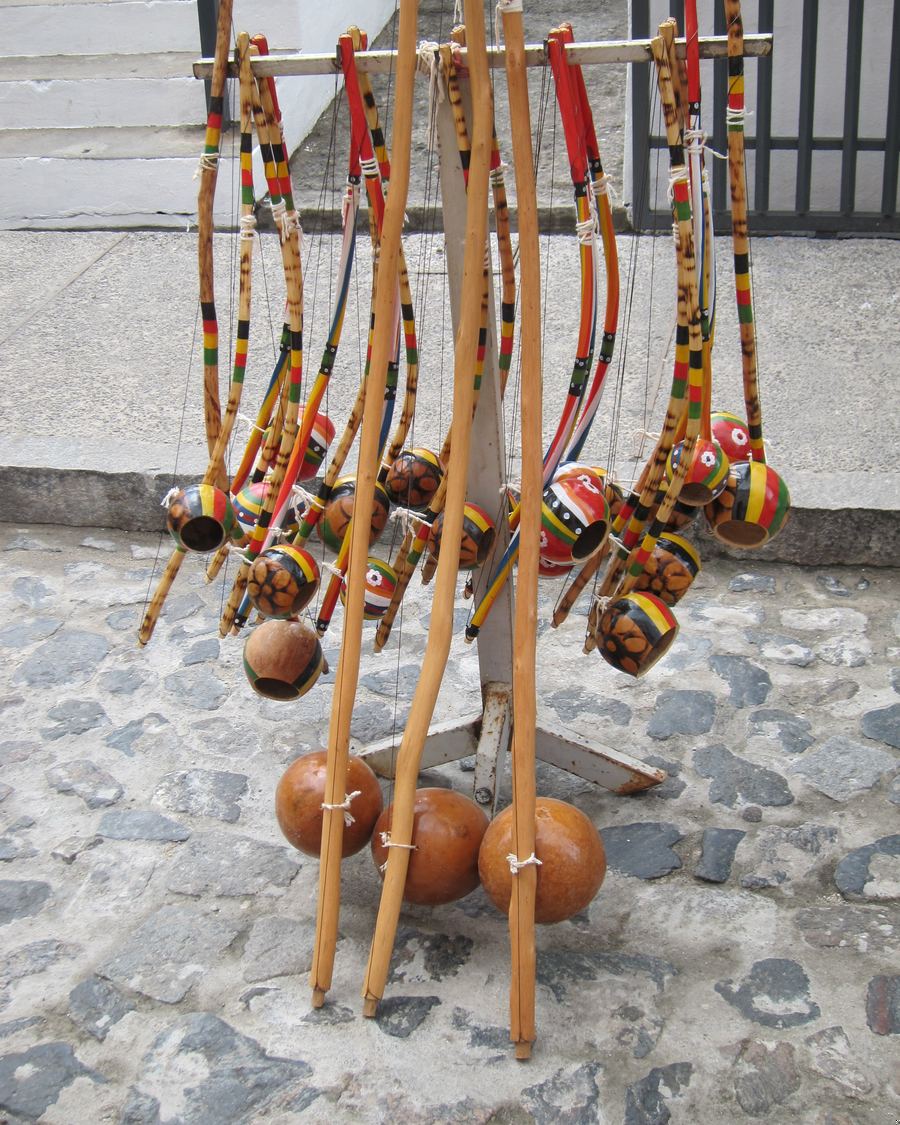
What is the berimbau?
The berimbau is one of the most singular instruments in the world: a one-string musical bow. Imagine a hunter's bow — a curved wooden rod tensioned by a wire — with a hollow gourd tied to the base as a resonance box. That is, in essence, a berimbau. And with that deceptively simple apparatus you can produce a hypnotic, metallic, vibrant sound that anyone who has ever watched capoeira recognises instantly.
Because the berimbau is not just another instrument within capoeira: it is the conductor. It marks the rhythm, decides whether the game will be slow and cunning (Angola) or fast and athletic (Regional), and gives the signal to start and stop. Without the berimbau there is no roda. Hence the Brazilian saying: "whoever truly learns capoeira, learns to play the berimbau."
From Africa to Brazil: the origin
The berimbau was not born in Brazil: its ancestors are African musical bows, such as the hungu or m'bulumbumba from Angola. They arrived in Brazil with enslaved people during the colonial era, and there merged with capoeira, the martial art disguised as dance that those same peoples created to resist and practise combat without being discovered.
With the recognition of capoeira as UNESCO Intangible Cultural Heritage of Humanity, the berimbau became a symbol of Afro-Brazilian identity and the sonic heart of every roda.
Parts of the berimbau
| Part | What it is | What it does |
|---|---|---|
| Verga | Flexible wooden rod (traditionally biriba wood) | Forms the arc and provides structure |
| Arame | Steel wire acting as the string (often from an old tyre) | The string that vibrates and sounds |
| Cabaza | Hollow gourd tied to the base | Resonance box and "wah" effect |
| Baqueta (vaqueta) | Thin wooden stick | Strikes the string to produce sound |
| Caxixi | Wicker rattle with seeds | Sounds with each strike, marks rhythm |
| Dobrão | Old coin or flat stone | Pressed against the string to raise pitch |
Remarkably, one musician handles all of this at once: one hand holds the verga and dobrão, the other strikes with the baqueta while the caxixi rattles, and the belly controls the cabaza. That is the magic — and the challenge — of the berimbau.
Gunga, médio and viola: the three berimbaus
| Berimbau | Pitch | Role in the roda |
|---|---|---|
| Gunga | Lowest (large gourd) | Carries the base, directs and commands the roda |
| Médio | Mid-range pitch | Plays the inverted rhythm, provides counterpoint |
| Viola (violinha) | Highest (small gourd) | Improvises, ornaments and adds flourishes |
For beginners, a médio or gunga is recommended: their balanced sound is ideal for learning the basic toques. The viola, higher and harder to control, is usually left for when you have developed some mastery.
How to play the berimbau step by step
Playing the berimbau is like rubbing your stomach and patting your head at first: many things at once. But getting the sounds is easy. Here is how to start:
- Hold the verga with your little finger. Grasp the arc vertically with your non-striking hand. The weight rests on the little finger, which goes through the gourd's loop; the other fingers wrap around the verga and the dobrão (coin) sits ready. The cabaza rests against your belly.
- Pick up the baqueta and caxixi. With the other hand hold the baqueta between thumb and index finger and hook the caxixi to those same fingers. Every strike on the string now comes with the rattle.
- Learn the three sounds. Open: strike without touching the string with the dobrão → low open note. Pressed: press the dobrão against the string when striking → note one tone higher. Buzzing (chiado): graze without fully pressing → a muffled buzzing fill sound.
- Control the cabaza. Move the gourd's opening towards and away from your belly: it is a wah effect. Pressed against you sounds closed and deep; open sounds bright.
- Your first toque. Chain open, pressed and buzzing in a repeated pattern. The Angola toque is slow and perfect for beginners; the São Bento Grande is the fast game rhythm. Go slowly and keep the pulse with the caxixi.
The classic beginner mistake is tensing the hand that holds the verga: the little finger bears almost all the weight and should stay comfortable. And you do not need to strike hard: good sound comes from precision, not force.
Common mistakes and how to fix them
| Problem | Cause | Fix |
|---|---|---|
| Little finger hurts quickly | Holding weight wrong or tensing it | Place little finger properly in the loop, relaxed hand, short sessions |
| Open and pressed sound the same | Not pressing the dobrão firmly enough | For pressed: press coin firmly; for open: remove it completely |
| Sound is muffled and lacks body | Gourd always pressed against belly | Open and close the cabaza to give timbre and volume |
| Caxixi does not sound on time | Moving stick and caxixi separately | They move together: the caxixi sounds on the same baqueta strike |
| Losing the rhythm of the toque | Trying a fast toque too soon | Start with the Angola toque (slow) and build up |
Berimbau vs other rare instruments
| Berimbau | Jaw harp | Cajón | |
|---|---|---|---|
| Family | Chordophone (musical bow) | Idiophone (mouth) | Percussion (box) |
| How played | Strike string with stick | Pluck tongue near mouth | Seated, hand strikes |
| Origin | Africa → Brazil (capoeira) | Universal, ancient | Peru → flamenco |
| Initial difficulty | Low-medium (coordination) | Low | Very low |
| Produces melody | Rhythm + 2–3 notes | Harmonics over a tone | No, rhythm only |
If you are drawn to the ancestral resonant sound using your body, also look at the kazoo. For percussion and accompaniment, the cajón is the easiest entry point.
Which to buy to start
For beginners, look for a complete berimbau that comes with all five pieces: verga, cabaza, baqueta, caxixi and dobrão (sometimes the coin must be bought separately). As your first instrument, a médio or gunga is the best option for their balanced sound. Avoid overly cheap souvenir models: the thin gourd cracks and the wire comes loose.
Frequently asked questions
What exactly is the berimbau?
A one-string musical bow originating in Brazil (with African roots) that directs capoeira. A flexible wooden rod (verga) tensioned by a steel wire, with a gourd (cabaza) that amplifies the sound. Struck with a thin stick while a coin (dobrão) changes the pitch.
Is the berimbau hard to play?
Getting the sounds is easy from day one; the hard part is coordinating stick, coin, caxixi and gourd simultaneously. With a few weeks of practice you can chain a complete toque. No music reading required.
Gunga, médio or viola to start?
A médio or gunga: their balanced pitch is ideal for learning the basic toques. The viola, being higher-pitched, is left for when you have developed some mastery.
What parts does a complete berimbau have?
Verga (rod), arame (wire/string), cabaza (gourd), baqueta (stick), caxixi (rattle) and dobrão (coin). When buying, check the set includes them all.
Can I play it without knowing music?
Yes. The berimbau is learned by imitation of toques, not reading sheet music. Mastering the three basic sounds and keeping the pulse is enough to play the Angola toque.