

Quick answer
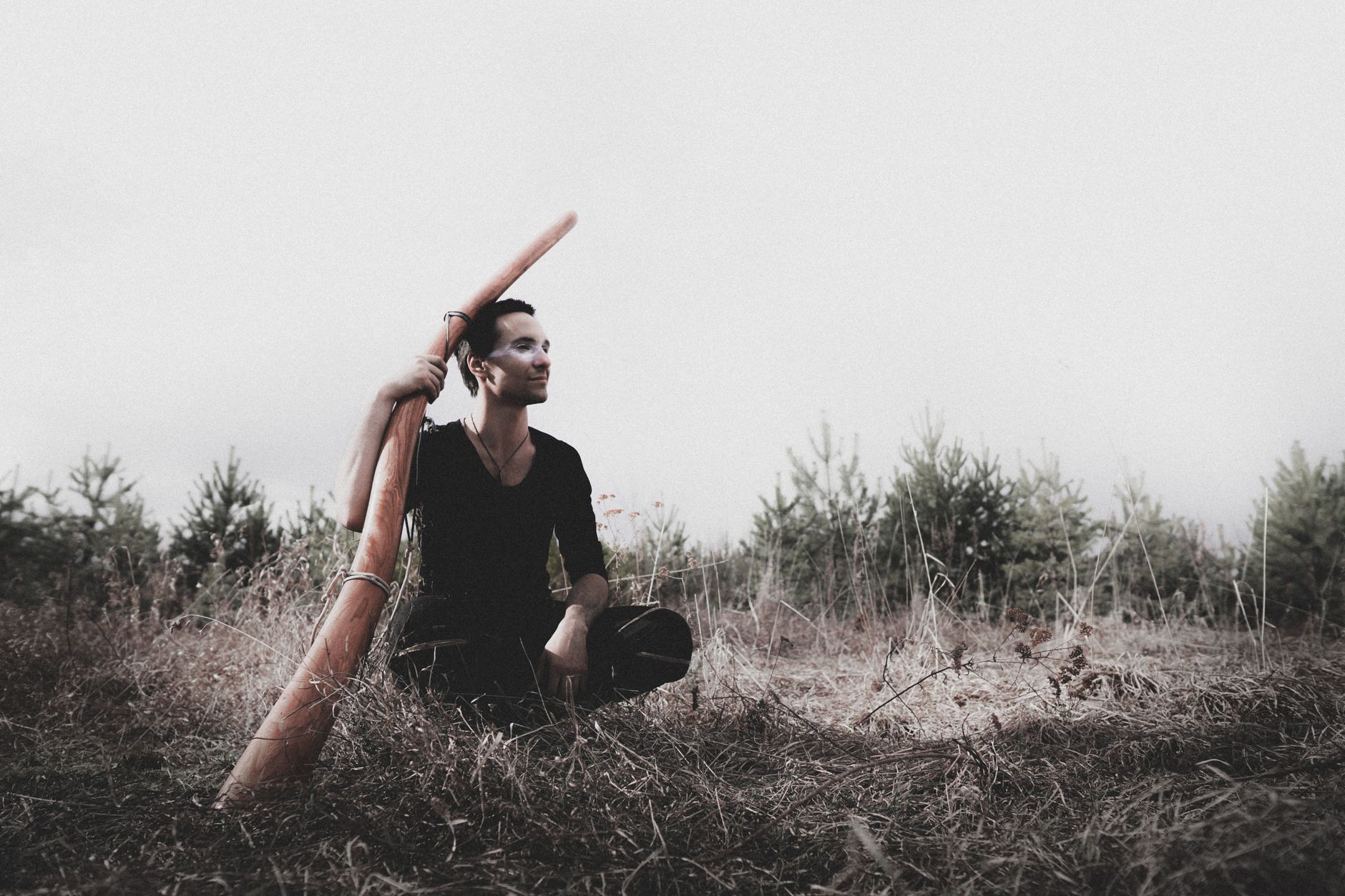
The didgeridoo is an ancient wind instrument of the Aboriginal peoples of northern Australia: a long tube (1 to 3 m), traditionally eucalyptus hollowed out by termites, sounded by buzzing the lips at one end. The result is a low, continuous drone that, with circular breathing, can be sustained for minutes without a pause. Easy to make a sound, fascinating to master. Beginner price: €25–120.
What is the didgeridoo?
The didgeridoo (also spelt didjeridu or didge) is a wind instrument from the Aboriginal communities of Arnhem Land, in Australia’s Northern Territory. Its use is documented for at least 1,500 years, making it one of the oldest wind instruments still played today.
The word “didgeridoo” is an onomatopoeic Western name imitating the instrument’s sound. Each Aboriginal people has its own traditional name — yidaki among the Yolŋu, mago elsewhere — each carrying its own cultural rules about who may play it and in which ceremonies.
Unlike most wind instruments, the didgeridoo has no holes or keys: it produces a single fundamental note (its drone) whose pitch depends on the tube length. All the musical richness comes from the player’s technique: tongue, throat and voice modulations.
How it sounds and how the sound is made
The base sound is the drone: a deep, steady buzz. You make it by relaxing your lips and letting them vibrate against the tube end, just like a loose-lipped “raspberry”. You don’t blow hard — you let the air make the lips vibrate.
From that drone, the player creates textures and rhythms by modulating:
- The tongue — saying “di-dle-di-dle” gives the characteristic rhythmic patterns.
- The throat and diaphragm — tensing the throat changes the timbre and adds harmonics.
- The voice — vocalising or imitating animals (the famous “bark” or the kookaburra call) while holding the drone creates striking effects.
- Trumpeting — jumping up to an overtone for accents.
Circular breathing: the big challenge
The technique that makes the didgeridoo famous is circular breathing: it sustains the sound without pauses for minutes. The trick is to store air in your cheeks and push it into the instrument like a bellows, while inhaling through the nose at the same time, so the airflow into the tube never stops.
A good way to learn it is to practise first with a glass of water and a straw: blow continuous bubbles while sniffing in through your nose every few seconds. Once you can keep the bubbles uninterrupted, transfer that feeling to the didgeridoo. It is the same technique some saxophonists and oboists use for long held notes.
Materials and types of didgeridoo
| Material | Sound | Price | Best for |
|---|---|---|---|
| Eucalyptus (traditional) | Warm, authentic, rich harmonics | €150–500+ | Authentic sound, collecting |
| Bamboo | Good, slightly drier | €25–60 | Affordable starter |
| Agave / local wood | Light and resonant | €40–90 | Price-to-sound balance |
| Fibre / telescopic | Tunable, very durable | €50–120 | Travel, adjusting the note |
The fundamental note depends on length: a longer didgeridoo gives a lower note. Models in D and C are most popular for beginners because they balance size and playability well.
How to start playing, step by step
- Relax your lips against the mouthpiece. Buzz them loosely (a low raspberry) without tensing.
- Find the drone: adjust lip tension until the tube resonates with a clean, steady buzz.
- Add the tongue: think “di-dle-di-dle” for the basic rhythm.
- Bring in the voice: hum an “ooo” or “aaa” while holding the drone to enrich the timbre.
- Practise circular breathing with the straw and water before applying it to the instrument.

Which to buy and where
For your first didgeridoo, start with a bamboo or telescopic fibre model: affordable, durable and, in the telescopic case, tunable while you learn. Save authentic eucalyptus for when you have mastered the drone and circular breathing and want the most traditional sound.
Before buying, check the fundamental note (D or C are easiest to start), the mouthpiece diameter (beeswax ones can be moulded to your mouth), and a smooth interior that makes the drone easier.
As an affiliate, Otamatone.club may earn a small commission on qualifying purchases at no extra cost to you.
Frequently asked questions about the didgeridoo
What is a didgeridoo?
An ancient wind instrument of northern Australia’s Aboriginal peoples: a long (1-3 m) eucalyptus tube that produces a low drone when you buzz your lips at one end. One of the world’s oldest wind instruments.
Is it hard to play?
The basic drone is easy (buzz loose lips). The hard part is circular breathing, which can take weeks or months to master.
What is circular breathing?
A technique for continuous sound: push air from your cheeks into the tube while inhaling through your nose at the same time.
How much does it cost?
Beginner (bamboo/fibre) €25-120. Authentic handmade eucalyptus from €150 upward.
Any health benefits?
Studies link it to reduced snoring and mild sleep apnoea by strengthening the upper airways and throat.
Other curious instruments
- Tibetan singing bowl — vibrating sound for meditation and relaxation
- What is an Otamatone? — the quirky Japanese singing instrument
- Otamatone Deluxe — the XL singing note with a headphone jack