
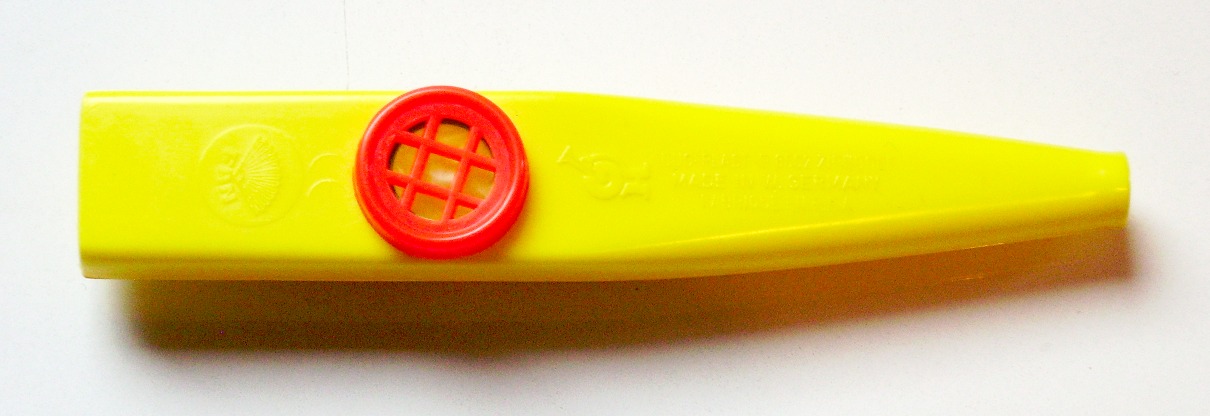
What is a kazoo?
The kazoo is a small musical instrument — technically a mirliton — with one unmistakable trait: you do not blow it, you sing into it. It is tube-shaped, usually plastic or metal, with a small chamber at the top containing a thin membrane. When you hum or sing through the mouthpiece, your voice makes that membrane vibrate and adds a nasal, buzzing, wonderfully funny quality to the sound. It is the instrument of jug bands, classic jazz, parties, and New Year's Eve, and probably the easiest instrument in the world to play.
Unlike a flute, harmonica or melodica, the kazoo produces no notes of its own: it amplifies and colours the melody you sing. That is why it is perfect for anyone who has never played anything: if you can hum a song, you can play it on the kazoo in seconds.
How it works: the buzz secret
Inside the kazoo there is a resonant membrane (originally thin waxed paper, today often mylar plastic). When you make sound with your voice, the sound waves reach that membrane and make it vibrate rapidly. That vibration is superimposed on your voice and creates the characteristic "bumblebee" kazoo timbre. It is the same principle as the old wax-paper-and-comb trick many tried as kids: voice alone is not enough — something must vibrate with it.
This explains the number-one beginner mistake: blowing air without voice. If you just blow, nothing happens, because there is no sound to set the membrane vibrating. The key is to sing, hum, or say syllables into the mouthpiece.

How to play the kazoo step by step
You will be playing in under a minute. Follow these steps:
- Place the wide end against your lips. The large open end goes against your mouth, not the narrow tip.
- Do not blow — sing. Say "doo", "du" or "too" with your voice. You will immediately hear the characteristic buzz.
- Hum a melody you already know. You set the pitch with your voice; the kazoo just colours it. Try "Happy Birthday".
- Articulate syllables. To separate notes, say "du-du-du" instead of one long "duuuuu". That articulation marks the rhythm.
- Play with dynamics. Singing louder or softer changes the sound character; experiment with vibrato and dynamics.
That is it. No fingering, no sheet music, no music theory required. The kazoo is pure amplified voice.
Video: how to play the kazoo
In this video you see the "doo" technique in action and how to separate notes with voice articulation.
Types of kazoo: plastic, metal and electric
| Type | Sound | Price | Best for |
|---|---|---|---|
| Classic plastic | Nasal, light | $2 – $6 | Children, parties, first-timers |
| Metal (brass/zinc) | Louder, brighter | $8 – $15 | Jug band, jazz, live performance |
| Professional with spare membranes | Adjustable, durable | $12 – $25 | Musicians who use it regularly |
| Electric / with mic | Amplifiable with effects | $20 – $50 | Recording and stage |
The classic plastic (often submarine-shaped) is the icon of the instrument and the best first buy. For a more powerful sound that lasts years, the metal version is worth it.

Kazoo vs other easy instruments
| Kazoo | Kalimba | Melodica | |
|---|---|---|---|
| Difficulty | Very easy (zero technique) | Easy | Easy–medium |
| Produces own notes | No (follows your voice) | Yes | Yes |
| Price | $2 – $15 | $20 – $60 | $25 – $90 |
| Sound type | Fun buzzing | Sweet, metallic | Warm wind |
If you want an instrument that sounds surprisingly serious, look at the kalimba or melodica. If you want instant, cheap fun for the whole family, the kazoo wins.
Easy songs to start with
Since the kazoo follows your voice, any song you can hum works. These are perfect for the first few minutes:
- Happy Birthday — short, familiar and with clear notes.
- Twinkle Twinkle Little Star — simple, repetitive melody.
- When the Saints Go Marching In — the jug-band and Dixieland classic, made for kazoo.
- Pop choruses you already know — hum them and let the buzz do the rest.
Care and maintenance
The kazoo needs almost no care, but the membrane is its weak point. Keep it dry: excessive saliva moisture can deteriorate wax-paper membranes. If the sound becomes muffled, it is almost always a loose or damaged membrane — on good models you can replace it with a spare. Clean it with a soft cloth on the outside. Well cared for, a metal kazoo lasts for years.
Where to buy a kazoo
To start well, choose a metal kazoo (louder, lasts longer) or a plastic pack for the whole family:
Amazon.com — no affiliate tag.
Frequently asked questions
Is the kazoo hard to play?
No — it is probably the easiest instrument in the world. If you can hum a melody, you can play the kazoo in under a minute.
Why does my kazoo not make a sound when I blow?
Because the kazoo is not blown — it is sung. Say "doo, doo, doo" with your voice to make the membrane vibrate.
How much does a kazoo cost?
Plastic: $2–$6. Quality metal: $8–$15. One of the cheapest instruments around.
How does the kazoo work?
A thin membrane inside vibrates when your voice enters — superimposing the characteristic buzz on your vocal sound.
Which type of kazoo is best to start with?
Classic plastic for price; metal for better sound and longevity.
Can children play the kazoo?
Yes — no technique needed, immediate results. Supervise very young children due to small parts.