
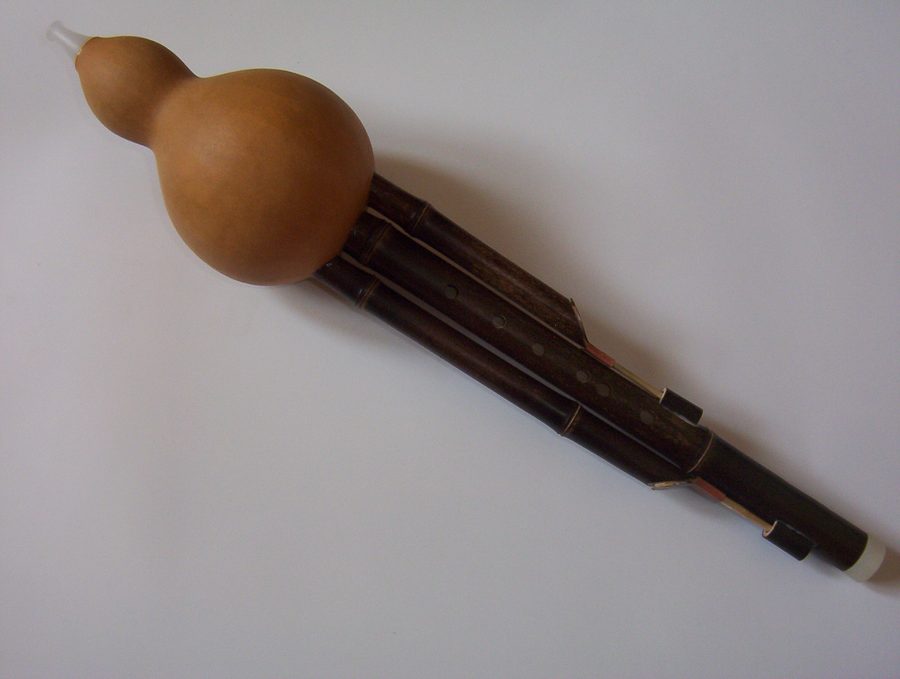
What is a hulusi?
The hulusi (脾节乌, meaning "gourd silk") is a traditional Chinese free-reed wind instrument with an unmistakable shape: a dried gourd acts as an air chamber, and from it hang three bamboo tubes. The central tube carries the finger holes and plays the melody; the other one or two side tubes are the drone — a fixed low note that sounds continuously underneath the melody, like a bagpipe.
It originated among the Dai, Achang and De'ang peoples of Yunnan province in southwest China, where it is used in love songs, dances and traditional ceremonies. In recent decades the hulusi has found audiences far beyond China, thanks to its beautiful tone and the fact that almost anyone can produce their first notes within minutes.
How it works: the gourd, the reed and the drone
The secret of the hulusi is a tiny component: inside the main tube there is a small free reed made of copper or brass. When you blow through the gourd mouthpiece, air passes through that reed and makes it vibrate on its own. This is why, unlike a transverse flute or a dizi, you do not need to find any angle or "sweet spot": just blow gently and it sounds.
The gourd acts as a resonating chamber that rounds and warms the tone. The drone tubes work the same way: a fixed reed that vibrates as long as you blow, producing a continuous harmonic foundation that enriches the melody. A small plug lets you silence the drone if you prefer to play without it.
An instrument of love with centuries of history
Among the Dai, Achang and De'ang peoples, the hulusi has a romantic dimension: traditionally young men played it to court women, and its soft sound is associated with falling in love and calm. The gourd is also a symbol of good fortune and fertility in Chinese culture, adding layers of meaning to the instrument beyond its music.
In recent decades the hulusi has spread internationally, appearing in world music ensembles, meditation playlists and YouTube channels dedicated to unusual instruments. Its combination of easy playability and distinctive oriental character makes it one of the most intriguing entry points into traditional Asian music.
How to play the hulusi step by step
The great advantage: almost everyone gets notes on the first day. All you need is to cover the holes cleanly and blow gently:
- Hold the hulusi upright. Gourd up against the mouth, three tubes hanging down. Upper hand covers the top holes and lower hand covers the bottom holes; thumbs support from behind.
- Blow gently and steadily. A soft, continuous stream of air through the mouthpiece. Do not blow hard or the sound will squeak or break. Think "warm breath on cold hands".
- Cover holes with the pads of your fingers. Use the flat of your fingertip, not the tip. Every hole must seal completely or the note will be flat or airy. Check each finger one by one.
- Learn the scale. All holes open = highest note. Cover them one by one from the top down to descend the scale. Most hulusi in C have a range of an octave plus a few extra notes.
- Use the drone. Let the side tubes sound freely for a full, rich accompaniment. When you want clean solo melody without drone, insert the plug into the side tube(s).
- Add dynamics and expression. Vary your breath pressure slightly to add swells; use your fingers on the side holes for ornaments (trills, grace notes) as you gain confidence.
Video: how to play the hulusi
This lesson covers how to hold the hulusi, how to blow for a clean tone, how to cover the holes and how to use the drone — everything you need for your first notes and melodies.
Common mistakes (and how to fix them)
| Problem | Cause | Fix |
|---|---|---|
| High-pitched squeak | Blowing too hard | Blow much more softly and steadily |
| No sound at all | Holes not covered or reed stuck | Seal with finger pads; blow gently; check the reed |
| Note sounds breathy / fuzzy | Air leaking through a hole | Check each finger one by one until the note clears |
| Drone is annoying | Side tube open unintentionally | Insert the plug to silence the drone pipe |
| Going out of tune as you go higher | Changing breath pressure between notes | Keep air pressure constant; let fingers do the work |
Which hulusi to buy to start
The most important thing when buying your first hulusi is the key. C (do) is recommended for beginners: the most common key in teaching methods and online tutorials. Bb is also popular and sounds slightly warmer and deeper. Avoid high-pitched keys (F, G) to start.
| Type | What it is | Approx. price | Best for |
|---|---|---|---|
| Gourd + bamboo hulusi in C | Traditional, natural gourd body | $20–$50 | Starting out (best option) |
| ABS resin hulusi | Synthetic body, more durable, consistent | $15–$35 | Travel, humid climates, children |
| Premium handmade bamboo | Artisan, richer tone, better intonation | $60–$150 | Intermediate players |
Always buy a hulusi with a spare reed included, or check that replacement reeds are available. The reed is the most delicate part and can crack or go out of tune with heavy use.
Hulusi vs other easy instruments
| Hulusi | Melodica | Kalimba | |
|---|---|---|---|
| How you play it | Blow + cover holes | Blow + keyboard | Pluck lamellae with thumbs |
| Sound type | Sweet, oriental, with drone | Bright, accordion-like | Crystalline, music-box |
| Difficulty to start | Very easy | Very easy | Very easy |
| Starting price | $20–$50 | $25–$60 | $20–$40 |
If you enjoy blowing instruments and lyrical melodies, also compare with the melodica; for a purely tactile instrument without breathing, look at the kalimba.
FAQ
What does a hulusi sound like?
Sweet, soft and slightly nasal with an oriental character. The drone adds warmth and depth. It is often described as the most expressive wind instrument for slow, lyrical melodies — think of a gentler cousin of the bagpipes.
Can I play Western music on a hulusi?
Yes. A C hulusi can play any diatonic melody. With an ABS or chromatic hulusi you can reach all 12 semitones. Many players perform folk songs, pop melodies and classical pieces on it.
Do I need to know how to read music?
No. Many hulusi tutorials use numbered notation (jianpu) or finger diagrams. You can start learning melodies by ear within the first session.
Who is the hulusi for?
The hulusi is ideal for complete beginners who want to start with something forgiving and rewarding, lovers of world music and oriental sound, people looking for a relaxing and meditative instrument, and curious adults who want something truly different. It is cheap, sounds beautiful almost from day one and fits in any pocket. If you enjoy wind instruments and lyrical melodies, you will love it.