
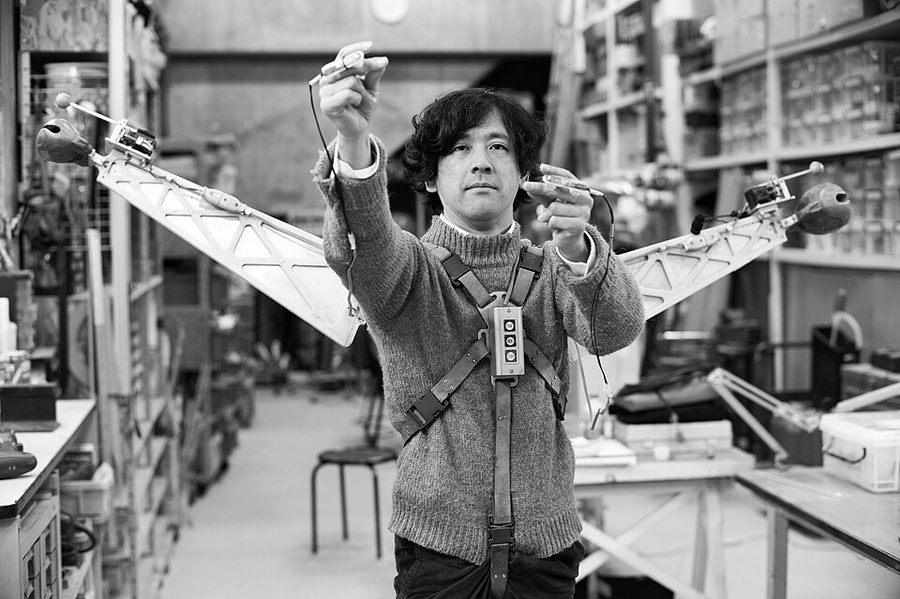
What is Maywa Denki?
Maywa Denki (明和電機) presents itself as a fictional company — a fake electric firm that is actually a Japanese art project. Founded in 1993 by brothers Masamichi and Nobumichi Tosa, who took the name from their father's small electronics factory, the group's great conceit is its tone: instead of acting as artists, they act as employees of a company. This is why they always wear the blue factory overalls typical of Japanese small factories.
The result is a body of work that blurs art, engineering, performance and humour — all under the banner of a company that does not actually sell electricity.
Nobumichi Tosa: The Brain Behind the Otamatone
After the death of his brother Masamichi, Nobumichi Tosa became the sole face of Maywa Denki. An artist, engineer and performer, he is instantly recognisable in his blue factory uniform. In 2009, he invented the Otamatone — arguably the most famous nonsense machine Maywa Denki has ever produced — and became a viral sensation in the process.
Nobumichi regularly performs with his instruments, gives talks on the intersection of art and technology, and continues to produce new projects under the Maywa Denki name.
Nonsense Machines: The Art of Absurd Utility
Maywa Denki calls its creations nonsense machines: objects that are real and functional but serve no practical purpose beyond being interesting, amusing or thought-provoking. The name deliberately inverts the usual value judgment — these things work perfectly, they are just working at something absurd.
Famous examples beyond the Otamatone include the Edelweiss series (robotic musical flowers) and the Naki fish robots. Each project treats technology with the same deadpan seriousness a factory worker would bring to a production line — which is the whole joke and the whole art.
The Otamatone: The Invention That Went Global
The Otamatone was invented in 2009 and quickly became a global phenomenon. Its combination of genuinely playable electronic instrument and absurdly expressive face — that singing mouth that opens and closes as you squeeze it — hit a perfect nerve online, generating millions of viral videos and making it one of the best-known novelty instruments in the world.
Today it comes in dozens of editions — Deluxe, Ninja, Kabuki, Cat, Hatsune Miku and many more — but all originated from the same 2009 Maywa Denki design.
How to Spot an Original Maywa Denki Otamatone
- Check the packaging: official products have clear Maywa Denki branding and an instruction sheet.
- Sound quality: imitations sound significantly worse — thinner tone, less responsiveness to the touch neck.
- Buy from reputable sellers: Amazon listings that specify "official Maywa Denki" or ship from Japan / established toy retailers are the safest bet.
FAQ
What is Maywa Denki?
A Japanese art collective that presents as a fictional company, creating nonsense machines — functional objects with no practical purpose. Founded in 1993 by the Tosa brothers; now led by Nobumichi Tosa.
Who is Nobumichi Tosa?
The artist and engineer who runs Maywa Denki and invented the Otamatone in 2009. Recognisable by his blue factory overalls.
What are nonsense machines?
Real, functional objects that serve no practical purpose — only to be interesting or amusing. The Otamatone is the most famous example.
How do I know my Otamatone is original?
Check for official Maywa Denki branding on the packaging, a clear logo on the instrument and an instruction sheet. Originals sound noticeably better than imitations.