
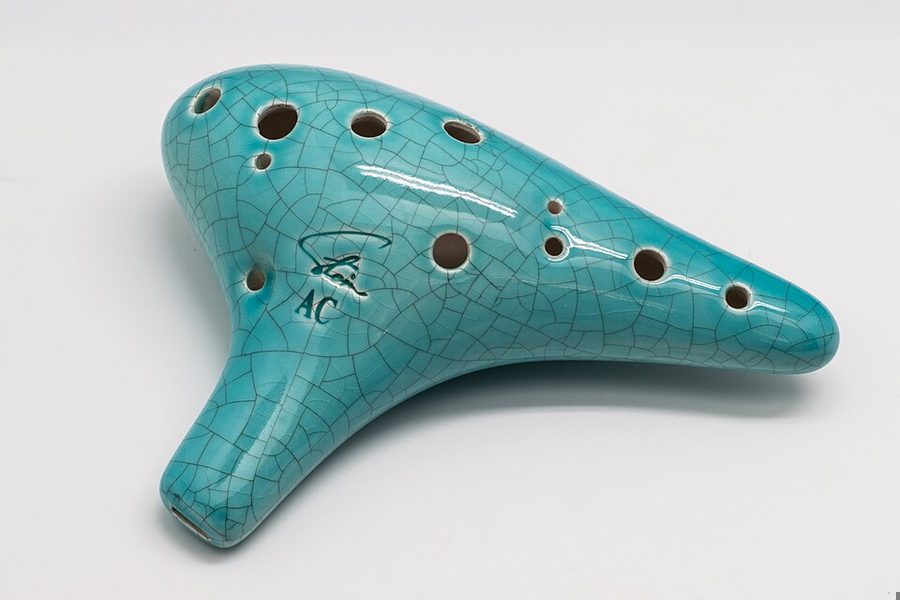
What is an ocarina?
The ocarina is a very special flute: instead of being a straight tube like a recorder, it is a closed hollow chamber — egg-shaped, potato-shaped or duck-shaped — in which air resonates inside. It belongs to the family of globular flutes, and that rounded body is exactly what gives it its characteristic sound: sweet, warm, round and slightly melancholic, like a soft, in-tune whistle.
You play it by blowing through a mouthpiece and covering a series of holes with your fingers. The more holes you uncover, the higher the pitch. It is typically made from ceramic or fired clay (hence "clay flute"), though plastic, wood and resin versions also exist.
It is one of the oldest instruments in human history — ocarinas over 12,000 years old have been found in China and in pre-Columbian cultures — but for many its modern fame comes from one very specific place: The Legend of Zelda: Ocarina of Time, the Nintendo game that turned this humble instrument into an icon.
The Zelda ocarina: from game to your hands
If you arrived here searching for "the Zelda ocarina", good news: it is a real instrument and you can buy it. The famous Ocarina of Time that Link plays is a 12-hole ocarina in blue, and identical commercial replicas exist that sound and play like any 12-hole C ocarina.
With one of these you can actually play the Song of Time, Zelda's Lullaby, the Bolero of Fire or the Song of Storms: the sheet music circulates everywhere in fingering notation (diagrams of which holes to cover). It is probably the most motivating way to start with an instrument: in an afternoon you are already playing a melody you recognise.
How many holes: 4, 6, 10 or 12
This is the number-one question before buying. The number of holes determines how many notes you can play:
| Type | Notes / range | For whom |
|---|---|---|
| 4 holes | Very few notes, almost a toy | Very young children, keyring souvenirs |
| 6 holes (English style / pendant) | A little over one octave | Getting started cheap, wearing around the neck |
| 10 holes | An octave and a half | Intermediate players, more repertoire |
| 12 holes (Zelda style) | Over one octave, complete | Recommended for beginners |
For most people, the best choice is a 12-hole ocarina in C major: enough notes for almost any song, the standard tuning with the most sheet music and tutorials, and exactly the type from Zelda. 6-hole ocarinas are a great alternative if you want something smaller, cheaper and more portable.
How to play the ocarina step by step
The great thing about the ocarina is that the first note comes within the first minute. Here is how to start:
- Cover all the holes. Hold the ocarina with both hands and cover each hole with the pad of your finger (not the tip). Make sure they are completely sealed: if air leaks through a gap the note goes out of tune. This is the lowest note.
- Blow gently and steadily. Bring the mouthpiece to your lips and blow a soft, continuous stream of air, as if fogging a mirror. Do not blow hard: the ocarina is very sensitive and if you overblow it will squeal and go sharp.
- Lift fingers to go higher. Uncover holes one at a time, following the fingering chart that came with your model. The more holes you open, the higher the pitch. Practise going up and down the scale slowly.
- Adjust air to match the pitch. Higher notes need slightly more air and lower ones slightly less. Learning to control breath pressure is the key to a well-tuned, even scale.
- Play your first song. With the fingering chart, try something simple: the Song of Time from Zelda, Happy Birthday or Twinkle Twinkle. Go note by note and repeat until it flows.
The classic beginner mistake is blowing too hard (the high notes go out of control) and not sealing holes properly (notes sound "dirty" or out of tune). Blow calmly, check your fingers and everything will fall into place.
Common mistakes and how to fix them
| Problem | Cause | Fix |
|---|---|---|
| High notes squeal or go sharp | Blowing too hard | Reduce air; high notes = controlled breath, not force |
| A "dirty" or halfway note sounds | A hole is not fully covered | Use the pad of the finger; check all holes seal |
| No sound at all when you start | Air not going straight into mouthpiece | Position lips correctly and blow a firm, clean stream |
| Getting lost in songs | Trying to read standard notation | Use fingering charts (hole diagrams) |
| Afraid of dropping and breaking it | Ceramic is fragile | Use a cord around your neck, or get a plastic model for travel |
Ocarina vs other easy instruments
| Ocarina | Melodica | Kalimba | |
|---|---|---|---|
| How it is played | Blow + cover holes | Blow + keyboard | Pluck tines with thumbs |
| Initial difficulty | Very low | Low | Very low |
| Portability | Fits in a pocket | Medium | High |
| Sound | Sweet, melancholic | Bright, accordion-like | Crystalline, relaxing |
| Starting price | Low | Medium | Low |
If you love the nostalgic sound and want something tiny to carry everywhere, the ocarina wins. If you prefer a keyboard, look at the melodica; and if you want thumb-plucked relaxation, the kalimba.
Which to buy to start
For starting from scratch and playing everything (including Zelda songs), the safe bet is a 12-hole C major ocarina — ceramic for home use, plastic if you are going to carry it everywhere or buying for a child.
Frequently asked questions
Does the Zelda ocarina really exist?
Yes. The Ocarina of Time from the game is a real 12-hole ocarina and identical replicas are sold. With any 12-hole C ocarina you can play the Song of Time, Zelda's Lullaby and other game melodies.
Is the ocarina hard to play?
It is one of the easiest wind instruments. The first note comes immediately and, following fingering charts, most people play simple songs within a week or two. The only challenge is controlling breath pressure.
How many holes should I buy?
12 holes in C major for beginners: most versatile, most tutorials, and Zelda-compatible. 6-hole models are a good smaller, cheaper alternative.
Ceramic or plastic?
Ceramic sounds warmer but is fragile; plastic sounds slightly flatter but is nearly indestructible and cheap — ideal for children and travel.
Do I need to know music theory?
No. Most songs are published in fingering diagrams so you can learn full melodies without reading notation.