
Quick answer
The shruti box (also called sur peti) is an Indian free-reed wind instrument that produces a drone (a continuous note) through metal reeds worked by a hand bellows. It gives singers and musicians their reference pitch in Indian classical music, kirtan, meditation and yoga. The usual range is C3-C5 (13-14 chromatic notes). Entry-level models cost around 40-80 USD.
What is a shruti box?
The shruti box — also called sur peti or shruti peti — is a small free-reed wind instrument originating in India. Its main function is to produce a continuous drone sound: a note (or set of notes) sustained without interruption, serving as the tonal reference for singers, instrumentalists and meditation practitioners.
The Sanskrit word shruti literally means "that which is heard", and in Indian music theory it refers to the microtones or intervals that form the basis of the scale. The shruti box supplies that fundamental note on which all improvisation or composition is built.
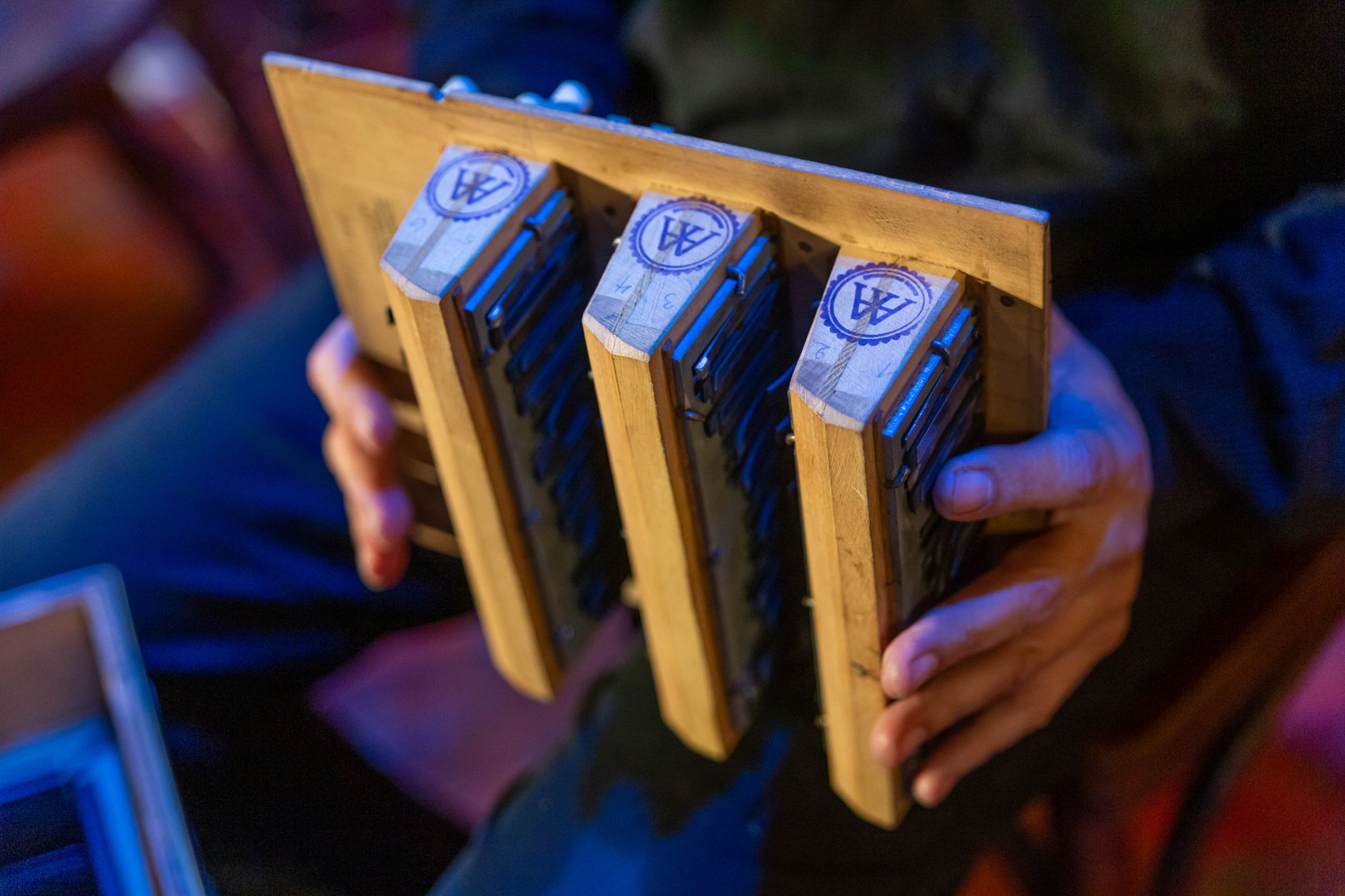
Structurally, the shruti box is a rectangular wooden box with a bellows system on one side and a set of tuned metal reeds inside. Each reed corresponds to a note and is activated by a small sliding key or button on top of the instrument.
Unlike other curious instruments such as the handpan (which takes years to master) or the theremin (which requires trained ears and very precise physical control), the shruti box can be used from day one with no prior musical training. You just pick the right note and move the bellows.
History: from the portable harmonium to the modern shruti box
The shruti box traces its roots to the harmonium, a Western free-reed instrument that arrived in India during the 19th-century British colonial period. The harmonium — with its full keyboard and foot-pumped bellows — was quickly adopted into Hindustani and Carnatic classical music, especially for devotional singing (bhajan) and classical vocal styles (khayal).
Indian musicians soon realized that many uses only required a simplified version producing the reference drone, without the full keyboard. That's how the sur peti was born, the direct ancestor of the modern shruti box: a smaller, lighter harmonium with fixed keys for the drone notes and none of the complexity of a melodic instrument.
In the 20th century, the growing popularity of yoga and meditation in the West turned the shruti box into a sought-after item outside India. Makers in the Miraj (Maharashtra) and Delhi regions developed more compact, affordable versions aimed at this international market. From the 2000s onward, electronic versions appeared — with a built-in speaker, battery and fine pitch control — removing the need to pump the bellows by hand.
Today the shruti box is used worldwide both by Indian classical musicians and by practitioners of kirtan, yoga nidra, Vipassana meditation and sound healing.

How the shruti box works: bellows and reeds
The shruti box mechanism is elegant in its simplicity:
Bellows system
The bellows occupies one of the instrument's side panels. Compressing and expanding the bellows by hand generates a continuous flow of air into the box. The player moves the bellows in a steady rhythm — almost like breathing — to keep the airflow unbroken. With practice, the motion becomes automatic and unconscious, freeing the player's attention for singing.
Metal reeds
Inside the box sits a set of brass or steel reeds, one per note. Each reed is fixed to a plate and vibrates at its natural frequency when air passes over it. Reed length and thickness determine the pitch: longer, thicker reeds produce lower notes; shorter, thinner ones produce higher notes.
Selector keys
Along the top of the instrument sits a row of small sliding keys (or buttons on some modern models). Each key controls a valve that opens or closes the airway to its reed. To produce a drone, you simply open the keys for the notes you want and keep the bellows moving.
Range and tuning
Most shruti boxes cover a range of C3 to C5 (two octaves), with 13 or 14 chromatic notes per octave. The total range usually runs to 13-22 reeds depending on the model. In practice, Indian music uses 2-4 notes simultaneously for the drone: typically the tonic (Sa), the fifth (Pa), the octave and sometimes the fourth (Ma).
Standard tuning is A=440 Hz, though many shruti boxes allow fine adjustment of ±20 cents to match the singer's voice.
How to use a shruti box: first steps
- Find your key: in Indian music, every singer has a natural key. If you don't know yours, try singing Sa (Do) at different pitches until you find the one that feels comfortable and resonant in your throat.
- Select the notes: open the keys for the tonic (Sa) and the fifth (Pa). For a richer drone, add the octave of Sa too. If your model spans two octaves, opening the low and high Sa together produces a particularly deep effect.
- Start the bellows: rest the instrument on your lap or a stable surface. Hold the bellows with your non-dominant hand and begin compressing and expanding it with a slow, continuous motion.
- Fine-tune it: if your shruti box has pitch control, adjust it until the drone resonates in unison with your voice singing Sa.
- Sing or meditate: once the drone is established, keep the bellows moving and immerse yourself in the sound. For meditation, simply listen to the drone and let your mind settle on it.
Tip: to keep the bellows motion from tiring your hand, use your whole forearm (not just the wrist) and practice maintaining even pressure. With 10-15 minutes of daily practice, the motion becomes fully automatic.
Model comparison: the best shruti boxes in 2026
A selection of models available on Amazon by level and use:
| Model / Type | Approx. price | Notes | Material | Level |
|---|---|---|---|---|
| Basic wooden shruti box | $40-60 | 13 notes (C3-C4) | Wood + brass | Beginner |
| Standard Indian sur peti | $70-120 | 22 notes (C3-C5) | Teak wood + steel | Intermediate |
| Electronic shruti box | $100-180 | 13 notes + fine tuning | Plastic + speaker | All levels |
| Professional Miraj sur peti | $180-300 | 22 notes + microtones | Sandalwood / teak | Professional |
| Premium electronic shruti box | $200-350 | All notes + MIDI | Metal + wood | Advanced / studio |
See all on Amazon → Professional sur peti →
As an Amazon Associate we earn from qualifying purchases. This comes at no extra cost to you.

Shruti box vs harmonium vs tanpura: which one to choose?
All three instruments serve similar roles in Indian music, but with important differences:
Shruti box
- Size: very compact (20-30 cm)
- Function: continuous drone only
- Technique: minimal — open keys and move the bellows
- Price: $40-300
- Best for: vocal practice, meditation, travel
Harmonium
- Size: large (60-90 cm), needs a table or floor space
- Function: melody + accompaniment + drone
- Technique: requires keyboard knowledge
- Price: $200-1,500
- Best for: trained musicians, advanced kirtan, studio work
Tanpura
- Size: long string instrument (100-130 cm)
- Function: plucked-string drone (4 strings)
- Technique: continuous plucking of the 4 strings in sequence
- Price: $150-800
- Best for: authentic Indian classical music, concerts
Bottom line: to get started with the Indian drone for meditation or vocal practice, the shruti box is the best choice for price, size and ease of use. The tanpura gives a more authentic timbre but needs more space and upkeep. The harmonium is the most versatile but also the most expensive and bulky.
If you're into other meditation and drone instruments, check out our kalimba guide too.
Shruti box in action: how it sounds
This video shows the real sound of a shruti box and how it is used in Indian vocal practice:
Frequently asked questions about the shruti box
What is a shruti box?
An Indian free-reed wind instrument with a hand bellows that produces a continuous drone. It gives the reference note in Indian classical music, kirtan, singing and meditation. It works similarly to a harmonium but without a full keyboard.
How does a shruti box work?
Through bellows and metal reeds: moving the bellows by hand sends air to the reeds of the notes selected with the sliding keys, producing a continuous, sustained tone.
What's the difference between a shruti box, a harmonium and a tanpura?
The shruti box is compact and only produces drones. The harmonium is bigger, with a full keyboard for melodies. The tanpura is a string instrument with a different timbre. For beginners, the shruti box is the most practical and affordable choice.
What notes does a shruti box have?
Most cover C3-C5 (two octaves) with 13-22 chromatic reeds. Standard models have 13-14 notes per octave; professional ones may include extra microtones.
What is a shruti box used for?
To give the reference drone in Indian classical singing, vocal practice, kirtan, meditation and yoga. It's especially useful for tuning the voice and staying focused during meditative practice.
How do you tune a shruti box?
Electronic models have a tuning dial. Mechanical ones are tuned by adjusting the reeds with a small screwdriver — best left to a technician. For everyday use, electronic models are far more convenient.
How much does a shruti box cost?
Entry-level: $40-80. Mid-quality: $80-150. Electronic: $100-250. Professional: $200-350. The price range is accessible for most musicians and practitioners.
Is the shruti box hard to play?
No. It's one of the most accessible instruments: anyone can produce a stable drone within 5 minutes. You just need to pick the right note and move the bellows with a steady, continuous motion.
Where to buy a shruti box
Amazon has the widest selection of shruti boxes, from basic wooden models to professional electronic versions with a built-in amplifier and fine pitch control.
All shruti boxes → Electronic models → Wooden sur peti →
As an Amazon Associate we earn from qualifying purchases. This comes at no extra cost to you.