
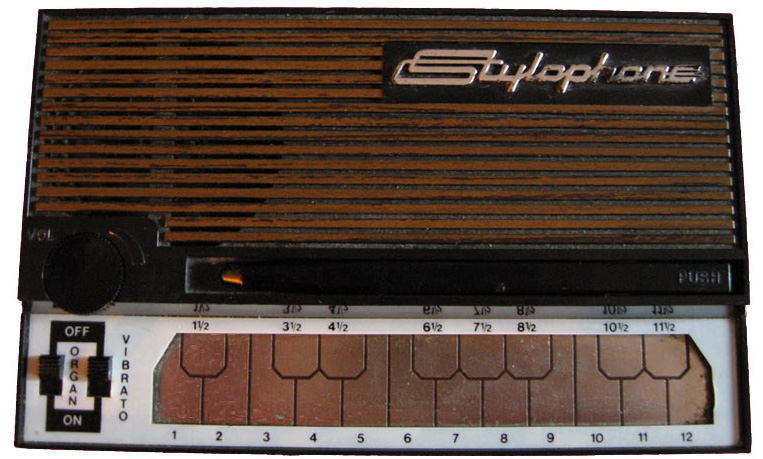
What is a stylophone?
The stylophone is a pocket analogue synthesizer with one unmistakable signature: instead of keys to press, it has a flat metal keyboard you play with a stylus (a metal pen). It was invented in 1968 by British engineer Brian Jarvis and commercialised by the brand Dübreq, which sold several million units in the 1970s. It fits in the palm of your hand, plays through its own speaker and produces that buzzing, nasal, nostalgic electronic timbre that defines an era.
Its fame surged when David Bowie used it in "Space Oddity" (1969), and since then it has been loved by retro-electronic musicians, collectors and the curious. Unlike a normal keyboard, the stylophone is simultaneously a musical toy, a cult instrument and a real synthesizer — a perfect oddity for anyone who wants to start making electronic music without spending hundreds.
How it works: the stylus that closes the circuit
The secret of the stylophone is astoundingly simple. Beneath the surface is a printed metal keyboard where each note is a small contact. The tip of the metal stylus is connected to the circuit: when you press it on a note, you close the circuit and an electronic oscillator generates the corresponding tone. Lift the stylus and the circuit opens — the sound stops.
The classic model adds a vibrato switch that slightly oscillates the pitch for expressiveness. Modern models like the Gen X-1 include real synthesizer features: different waveforms, an LFO (low-frequency oscillator) for modulation, an envelope shaping the attack and decay, and effects like delay. What started as a toy becomes a tool capable of basslines, leads and textures for music production.
How to play the stylophone step by step
Playing the first notes takes seconds; mastering stylus precision takes a little practice. Follow these steps:
- Switch on and set the volume. Insert batteries (or connect USB depending on the model), switch on and raise the internal speaker volume.
- Hold the stylus like a pen. Grip it firmly but relaxed; rest your wrist or little finger on the edge of the device for stability.
- Play a note. Press the tip on any metal key: it sounds while you maintain contact. Try the lowest note and work your way up.
- Slide to connect notes. Instead of lifting and lowering the stylus, slide it across the keyboard to play scales and legato melodies. This glissando is part of the instrument's charm.
- Turn on vibrato and experiment. Enable the vibrato switch for expression. On models like the Gen X-1, play with the waveform, LFO and delay to find your own sound.
The typical beginner mistake is playing "in jumps", missing notes: since contact depends on the stylus, practise slow, clean slides before increasing tempo.
Brief history: from 1968 to today
British engineer Brian Jarvis designed the stylophone in 1968 for the small company Dübreq, run by his father-in-law Reg Mason. It was marketed as an affordable pocket instrument that anyone could play without musical training, and it became a surprise commercial hit: Dübreq sold roughly 3 million units during the late 1960s and 1970s, helped by TV adverts fronted by comedian Rolf Harris.
Interest faded through the 1980s and 1990s, but the stylophone never fully disappeared from music culture. David Bowie's use of it on "Space Oddity" (1969) kept the instrument in the cultural memory, and it resurfaced on records by Kraftwerk and later Pulp. In 2007 Dübreq re-issued the classic model for a new generation of bedroom producers and retro-synth collectors, followed by digital-friendly versions like the Gen X-1 and the rhythm-focused Stylophone Beat, both aimed at people who want the original lo-fi charm with modern production features.
Video: how it sounds and how to play the stylophone
In this walkthrough you see how the stylus closes the circuit on each note and how the waveform, modulation and effects controls completely change the sound.
Models: classic, Gen X-1 and Beat
| Model | What it is | Approx. price | Ideal for |
|---|---|---|---|
| Stylophone classic (re-issue) | The original 1968 re-issued, monophonic with vibrato | $30 – $45 | Nostalgia, gift, discovering the instrument |
| Stylophone Gen X-1 | Portable synth with LFO, envelope, delay and multiple waves | $80 – $100 | Real music production, electronic music |
| Stylophone Beat | Pocket rhythm machine + bass synthesizer | $35 – $45 | Rhythms, lo-fi beats, portable jam |
| Stylophone S-2 / collector | Special and limited editions | Variable | Collectors and cult fans |
For most people, the choice is between the classic (price and nostalgia) and the Gen X-1 (if you want to use it seriously for music).
Stylophone vs other curious instruments
| Stylophone | Otamatone | Theremin | |
|---|---|---|---|
| How you play it | Stylus on flat metal keyboard | Sliding finger along the neck | Hands in the air, no contact |
| Difficulty | Easy–medium | Easy | Difficult (no fixed pitch) |
| Sound type | Synthetic, lo-fi vintage | Funny cartoon voice | Ethereal, sci-fi |
| Price | $30 – $100 | $30 – $70 | $100 – $600+ |
If you want Bowie's and Kraftwerk's retro electronic sound in your pocket, the stylophone is unbeatable. For something more gestural, compare with the theremin or the otamatone.
Songs and tips to start
- "Space Oddity" by David Bowie — the stylophone anthem; find the original line and copy it note by note.
- Film and video game melodies — the electronic timbre sounds great in retro 8-bit themes.
- Basslines and arpeggios — with the Gen X-1, try short bass notes and sequences for electronic production.
- Scales with glissando — slide the stylus up and down for that classic siren effect.
Key tip: mark the tonic position of your scale with a thin strip of tape or memorise it, because without raised keys it is easy to lose reference.
Care and maintenance
The stylophone is tough but has two sensitive points. First is the stylus: the piece most likely to go missing, so always store it in its clip and keep a spare if you can. Second is the metal keyboard: contact can get dirty over time giving intermittent notes; clean it gently with a dry cloth or very fine pencil eraser to restore contact. Change batteries when tone drops or volume falters, and store the device in a dry place. With those habits a stylophone works for decades — units from the 1970s still appear in perfect working order.
Where to buy a stylophone
To start, choose the re-issued classic for nostalgia and fun, or the Gen X-1 if you want to make real electronic music:
Amazon.com — no affiliate tag.
Frequently asked questions
What exactly is a stylophone?
A pocket analogue synth invented in 1968 by Brian Jarvis for Dübreq. Played by pressing a metal stylus on a flat metal keyboard — closing the circuit makes the note sound.
Is the stylophone hard to play?
No. The keyboard is labelled note by note; the challenge is precision with the stylus. Rest your hand and practise smooth slides between notes.
How much does a stylophone cost?
Classic re-issue: $30–$45. Gen X-1: $80–$100. Beat: $35–$45.
Why did David Bowie use the stylophone?
He used it in "Space Oddity" (1969), popularising its iconic lo-fi sound. Also appears in Kraftwerk, Pulp and retro-electronic recordings worldwide.
Which model should I buy to start?
Classic for nostalgia and discovery. Gen X-1 for real electronic music with modulation and effects.
Does it need batteries or a cable?
Batteries (9V or AA depending on model); many modern ones also accept USB. No amplifier needed — built-in speaker included.
Who invented the stylophone and when?
British engineer Brian Jarvis invented it in 1968 for the company Dübreq. It sold around 3 million units in its first decade thanks to affordable pricing and TV advertising.
Can you play real songs on a stylophone?
Yes. Notes are laid out like a small keyboard, so you can play melodies note by note, including well-known songs such as "Space Oddity". Precision takes practice since there are no raised keys to guide your fingers.